How Real-World Learning Experiences Build Critical Thinking Skills
Key Highlights
- Real-world learning connects classroom concepts with practical experiences.
- Experiential activities encourage curiosity, analysis, and independent thinking.
- Students develop problem-solving skills through hands-on experiences.
- Practical exposure helps learners make informed decisions.
- A balanced learning approach prepares students for future challenges.
Table of Contents
- Introduction
- About KR Mangalam World School
- How Do Real-World Learning Experiences Improve Critical Thinking Skills?
- Why Is Experiential Learning Important for Student Development?
- How Do Practical Activities Encourage Problem-Solving Abilities?
- Conclusion
- FAQs
Introduction:
Education becomes more meaningful when students can connect their classroom knowledge with real-life situations. At KR Mangalam World School, the Best CBSE Schools in Faridabad where while textbooks provide essential concepts, real-world learning experiences help students understand how these concepts work beyond academic boundaries. Activities such as projects, experiments, field visits, collaborative tasks, and practical applications encourage learners to observe, analyse, and develop solutions independently.
About Us:
KR Mangalam World School follows a progressive education approach that focuses on developing students academically, socially, and emotionally. The institution encourages experiential learning practices that allow learners to explore concepts through practical activities and meaningful experiences.
How Do Real-World Learning Experiences Improve Critical Thinking Skills?
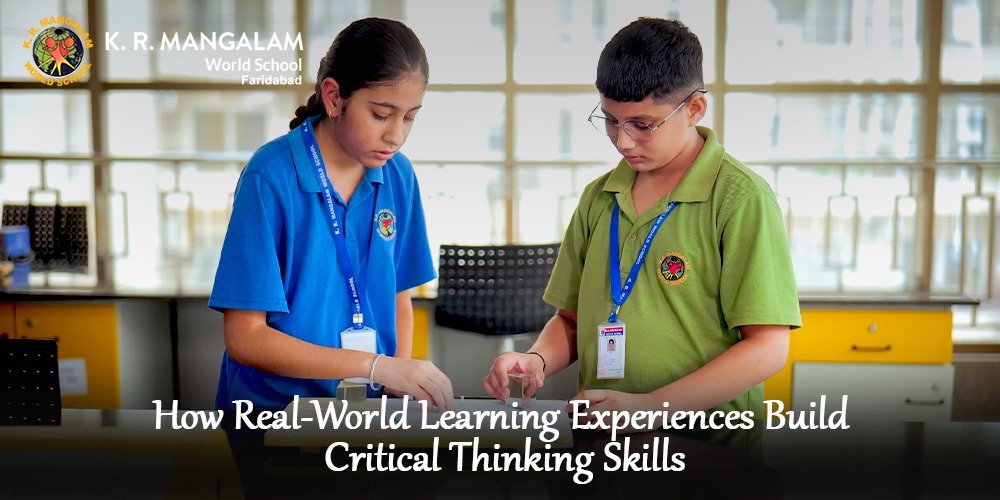
Real-world learning encourages students to move beyond simply receiving information and start analysing situations actively. When learners engage with practical challenges, they learn to identify problems, evaluate possibilities, and create solutions.
These experiences help students:
- Develop curiosity by exploring different perspectives.
- Analyse information before making decisions.
- Connect theoretical knowledge with practical applications.
- Improve reasoning and observation skills.
- Become independent learners.
| Real-World Learning Activity | Critical Thinking Skill Developed |
| Science Experiments | Analysis and evaluation |
| Research Projects | Investigation and reasoning |
| Community Activities | Decision-making and awareness |
| Presentations | Logical thinking and communication |
| Innovation Challenges | Creativity and problem-solving |
Through these activities, students learn that knowledge is not limited to classrooms. They understand how different concepts influence everyday life and develop the confidence to approach challenges logically.
Why Is Experiential Learning Important for Student Development?
Experiential learning allows students to learn by doing, reflecting, and improving. Instead of depending only on theoretical explanations, learners gain practical understanding through direct involvement.
This approach supports student development by:
- Encouraging active participation in learning.
- Improving memory through practical experiences.
- Developing creativity through exploration.
- Building confidence in applying knowledge.
- Promoting a deeper understanding of concepts.
When students experience real-life applications of their lessons, they become more engaged and motivated. They begin to see learning as an exciting process of discovery rather than only an academic requirement.
How Do Practical Activities Encourage Problem-Solving Abilities?
Problem-solving is an essential skill that helps students handle challenges effectively. Real-world activities provide situations where learners must think critically, consider different options, and create practical solutions.
Students develop problem-solving abilities through:
- Working on projects that require planning and execution.
- Finding solutions during experiments and activities.
- Collaborating with peers to overcome challenges.
- Evaluating results and improving their approaches.
- Applying creative thinking to real situations.
Such experiences teach students that challenges are opportunities for learning. They develop resilience and become comfortable with exploring different solutions instead of relying on a single answer.
Conclusion:
Real-world learning experiences play an important role in developing critical thinking skills among students. By connecting classroom concepts with practical situations, learners develop curiosity, creativity, and problem-solving abilities. These experiences encourage students to think independently and approach challenges with confidence.
FAQs:
Q. 1 Why are real-world learning experiences important for students?
Ans : They help learners connect classroom concepts with practical situations and develop deeper understanding.
Q. 2 How does experiential learning improve critical thinking?
Ans : It encourages students to analyse problems, explore solutions, and make informed decisions.
Q. 3 What activities help students develop practical thinking skills?
Ans : Projects, experiments, research activities, and hands-on tasks promote creativity and reasoning.
Q. 4 How do real-life experiences improve problem-solving abilities?
Ans : Students learn to evaluate situations, consider different solutions, and apply knowledge effectively.
Q. 5 Why is practical learning becoming important in education?
Ans : It prepares students with skills needed to adapt and succeed in changing environments.
Q. 6 How does KR Mangalam World School promote experiential learning?
Ans : KR Mangalam World School provides practical learning opportunities that encourage curiosity and independent thinking.