Is Tuition Really Necessary? How to Decide (and What to Try First)
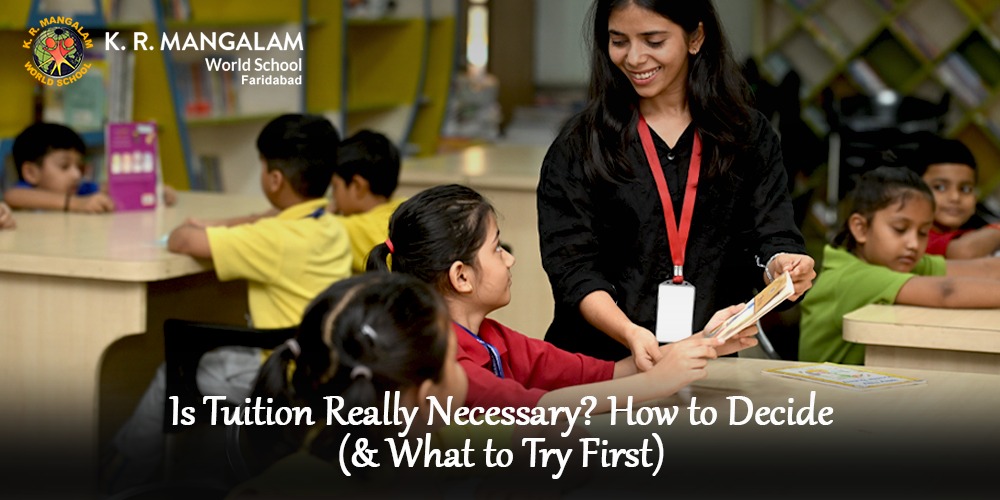
Ask a few parents about their child’s after-school routine, and you will often hear the same thing: “He has tuition for maths and science.” With so many children attending extra classes, parents worry that skipping tuition means falling behind. But does every child really need it? Often the answer is no, and an extra class may even add to stress.
We at K.R. Mangalam World School, Faridabad, highly trusted as one of the top schools in Faridabad, understand why this question weighs on so many parents. In this blog post, we help you decide whether your child truly needs tuition and share what you can try first. Read till the end.
Why Do So Many Parents Rush to Tuition?
Tuition has become a default for many families. Parents worry about competition, fear that their child is missing something, or see other children attending and feel pressure to follow. Working parents may also lack the time to guide homework themselves. These concerns are valid, but tuition is not always the right answer to them.
Signs Your Child May Need Extra Support
- Marks drop steadily in a subject despite regular effort
- Your child avoids a subject or says they “don’t understand anything”
- Homework takes far longer than it should
- Basic concepts from earlier classes are still shaky
Signs Your Child May Not Need Tuition
- Your child understands most lessons and makes only occasional errors
- Scores are steady and homework is completed independently
- The real issue is distraction, tiredness, or a lack of routine
- Your child is already overloaded with activities
What to Try Before Hiring a Tutor
1. Talk to the Class Teacher
Teachers see how your child learns every day and can pinpoint exactly where the difficulty lies. This single conversation often saves months of guesswork.
2. Fix the Routine First
A fixed study time, a quiet space, and enough sleep solve more problems than many parents expect. Tired and distracted children struggle regardless of how many classes they attend.
3. Encourage Questions in Class
Many children stay silent when they don’t understand. Encourage your child to ask doubts in class and to use any doubt-clearing support the school offers.
4. Build Self-Study Skills
Teach your child to make short notes, revise regularly, and attempt practice questions independently. A child who can study alone is far less likely to need outside help.
5. Spend 20 Focused Minutes Together
Ask your child to explain what they learned today. Teaching you reveals what they actually understand, and it takes only a few minutes.
If You Do Choose Tuition
Choose it for a specific problem, with a clear goal and a time frame. Prefer small groups that follow the school syllabus, and review progress after two to three months. Avoid overloading your child, as rest, play, and self-study time matter too.
How We Support Learning Without Tuition at Our School
At K.R. Mangalam World School, Faridabad, we aim to make the school day itself the place where learning is completed, so that children and parents do not feel the need to look elsewhere for understanding. Here is what that looks like:
- Concept-first CBSE teaching: Our Foundation, Primary, Middle, and Senior programmes build on one another, so that strong basics are laid before concepts become more demanding.
- Personalised attention and support: Teachers track each child’s progress, and students who need extra help receive it through our intervention spaces.
- Learning by doing: Labs, an activity room, and a simulation centre let children apply what they learn instead of memorising it for the exam.
- Thinking skills: Our focus on critical thinking and problem-solving helps children handle unfamiliar questions with confidence, rather than depending on ready-made notes.
- Time for everything else: With academics and co-curricular activities handled during the school day, evenings can be left for rest, play, and family time.
If you ever feel your child needs more support, we encourage you to speak to the class teacher first. Together, you can decide whether the answer is a change in routine, extra help at school, or something more.
Frequently Asked Questions (FAQs)
Q. Is tuition necessary to score well in CBSE exams?
No. Many students score well through regular school learning, consistent revision, and practice. Tuition helps only when there is a specific gap to fill.
Q. How do I know if my child needs a tutor or just better study habits?
If your child understands lessons but struggles with discipline and revision, work on habits first. If core concepts remain unclear despite effort and teacher support, a tutor may help.
Q. Can too much tuition harm my child?
Yes. Overloading leaves little time for rest, play, and self-study, and it can create dependence on outside help.
Q. What should I look for in a good tutor?
Look for clear communication, alignment with the school syllabus, a focus on understanding rather than rote learning, and regular feedback to parents.
Q. At what class does tuition become common?
It is often seen from middle and senior classes, but the need depends on the child, not the class. Younger children usually benefit more from parental guidance and play-based practice.
Conclusion
Tuition is neither good nor bad; it is a tool. The key is to understand your child’s real need before reaching for it. Often a conversation with the teacher, a steady routine, and a little focused time at home are enough.
If you are looking for a school where classroom learning itself builds strong foundations, we would love to hear from you. K.R. Mangalam World School, Faridabad, is listed among the top schools in Faridabad and combines a rigorous CBSE curriculum with personalised support, so that every child can learn with confidence