Maths Anxiety in Children: How to Turn “I Hate Maths” into “I Get It!
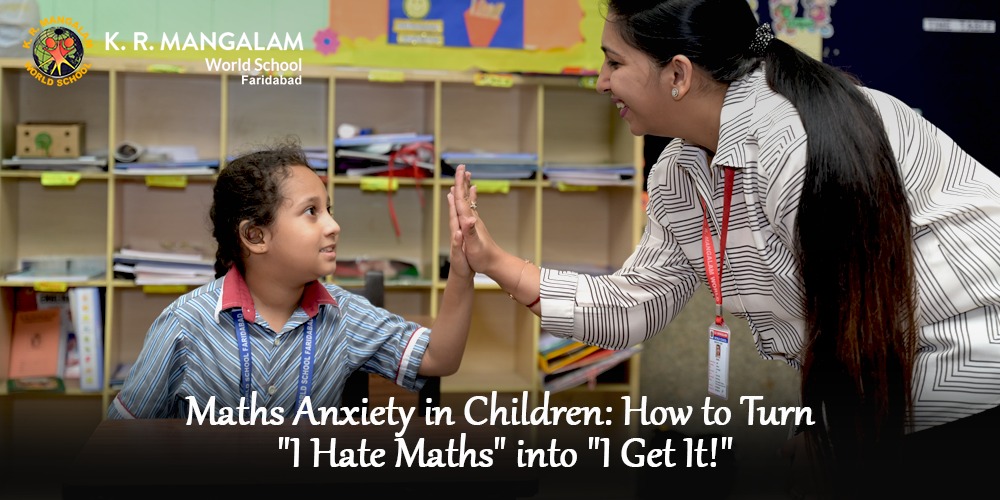
It is 7 pm. The maths notebook is open, the pencil has been sharpened twice, and your child has suddenly remembered that the water bottle needs refilling. Again. Then comes the familiar line: “I’m just not a maths person.” If this sounds like your home, you may be seeing maths anxiety, which is far more common than most parents realise. The good news is that this fear is learned, which means it can be unlearned too.
We at K.R. Mangalam World School, Faridabad, positioned among the top CBSE schools in Faridabad, know how much a child’s early experience with numbers shapes their confidence. In this blog post, we decode what anxious children often say about maths, what they really mean, and how you can respond. Read till the end.
Why Does the Fear Start?
Maths anxiety rarely appears overnight. It usually grows from a missed concept, a moment of embarrassment in class, pressure to be fast, or remarks like “I was bad at maths too.” Once a child expects to struggle, worry takes up the mental space that maths needs. So the best place to begin is by listening to what your child says.
What Your Child Says vs. What It Often Means
“I’m just not a maths person.”
What it often means: Your child believes ability is fixed, so every mistake feels like proof.
Try saying: “You’re not there yet. Which part feels tricky?” The word ‘yet’ tells them that skill can grow.
“I’ll do it later.”
What it often means: Avoidance. Maths feels like a threat, so delay feels like relief.
Try this: Start with a five-minute warm-up on a question they can already solve. An early success lowers the wall.
“My head hurts” or “my tummy hurts” before maths
What it often means: Anxiety can show up in the body, and the pain may be real even when there is no illness.
Try this: Stay calm, try a few slow breaths together, and keep the first task short and easy. Avoid turning it into an argument.
“I knew it at home, but I forgot in the test.”
What it often means: Worry is blocking recall under pressure. The knowledge is there, but the nerves are in the way.
Try this: Practise in relaxed conditions first, then add a timer gradually. Teach your child to take a breath before starting a paper.
“Everyone else finishes before me.”
What it often means: Your child is comparing speed, not understanding.
Try saying: “I care more about how you think than how fast you finish.” Praise accuracy and method over speed.
A Week of Maths Without a Worksheet
Confidence grows when maths feels like part of everyday life. Try one of these each day:
- Monday: Let your child work out the bill and the change during a shopping trip.
- Tuesday: Halve or double a recipe together and talk about fractions.
- Wednesday: Play Ludo, Uno, or chess. All three quietly build number sense and logic.
- Thursday: Ask for estimates on the drive: how long will it take, and how far is it?
- Friday: Let your child be the teacher and explain a concept to you.
- Saturday: Give a small pocket-money budget and ask them to plan how to spend it.
- Sunday: Take a break, or share a fun mental-maths puzzle over lunch.
How We Make Maths Friendlier at Our School
At K.R. Mangalam World School, Faridabad, we want children to see maths as something to explore, not fear. In our Primary and Middle programmes, concepts are built step by step through activities and lab experiences, so that numbers connect with real situations instead of staying abstract. Children are encouraged to ask questions and attempt answers without worrying about being wrong, because a classroom should feel safe enough for mistakes to become lessons.
Personalised attention plays a big part too. Teachers track each child’s progress, and our intervention spaces help students revisit a concept before it grows into a fear. Beyond the textbook, chess is part of our sports programme, while our robotics and ICT 360 coding curriculum, which includes game development, lets children use logic and problem-solving in ways that feel more like play than practice.
If your child seems anxious about maths, a conversation with the class teacher is a good place to begin.
Frequently Asked Questions (FAQs)
- What are the signs of maths anxiety in children?
Common signs include avoiding maths homework, headaches or stomach aches before maths, freezing during tests, saying “I can’t do it”, and careless errors under pressure.
- Is maths ability something a child is born with?
No. Maths skill grows through practice, understanding, and confidence. With the right support, any child can improve.
- How much time should my child spend on maths daily?
For most school-going children, 15 to 30 minutes is enough. Consistency matters more than long hours.
- Should I hire a maths tutor for an anxious child?
Not automatically. Start with the class teacher, strengthen the basics, and encourage low-pressure practice. A tutor can help with specific gaps, but patience matters more than extra hours.
- How long before my child’s confidence improves?
Many parents notice a change within a few weeks of regular, low-pressure practice. Deeper fears may take longer.
Conclusion
The next time your child says “I hate maths,” listen for what lies underneath. Behind those words there is usually a worry, a gap, or a comparison, and each can be gently addressed. With patience, calm responses, and a little everyday practice, “I hate maths” can slowly become “I get it.”
If you are looking for a school that helps children build confidence in every subject, we would love to welcome you. K.R. Mangalam World School, Faridabad, is ranked among the top CBSE schools in Faridabad and focuses on concept clarity, activity-based learning, and personalised support for every student.
To know more about our learning approach and subject support, feel free to make a campus visit or write to us at faridabad@krmangalam.com.